

- prev
- next
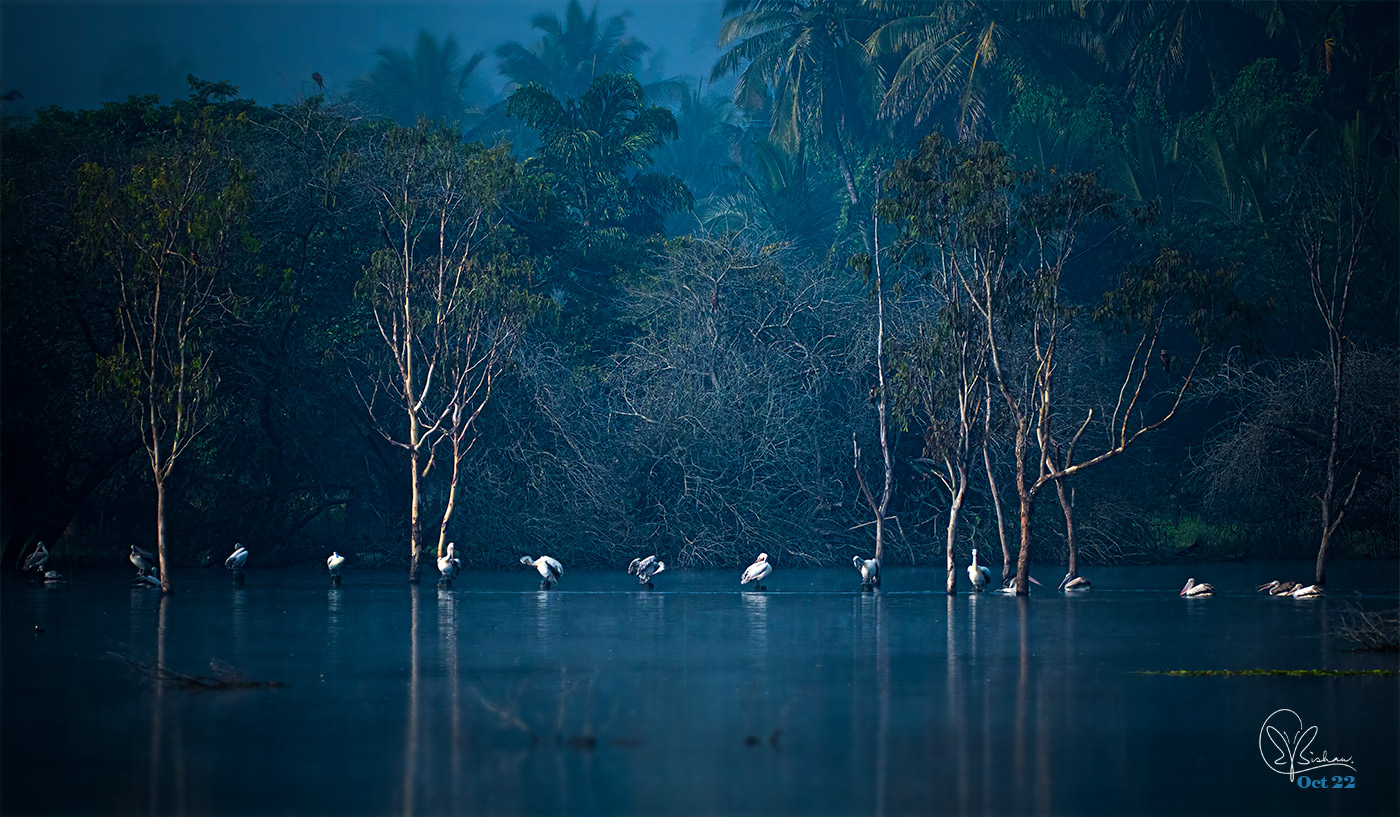
Common Name: Spot-billed Pelican
Pelecanus philippensis
Location: Perumbadi Lake, Kannur Kodagu Rd, Karnataka 571218, India
Sighting date: October 2, 2022
Photographer

Field Observation
A congregation of Spot-billed Pelicans observed roosting and preening on a flooded landscape at dawn, standing among submerged trees with coconut palms and dense riparian vegetation visible in the background. The deep blue pre-dawn light and still water surface suggest an early morning observation, likely at a seasonal reservoir or tank in coastal Karnataka. Approximately fifteen to twenty individuals are visible, distributed across the shallow water in loose groupings — some preening, others standing at rest. The scene is characteristic of the Spot-billed Pelican's preference for large, calm inland water bodies with partially submerged perch structures.
The Spot-billed Pelican (Pelecanus philippensis), also known as the Grey Pelican, is one of the larger waterbirds of southern Asia, breeding across a broad range from southern Iran through India east to Indonesia. At distance the species can be difficult to separate from other pelicans in the region, but at close range the distinctive spots on the upper mandible, the absence of bright facial colour and the overall greyer plumage distinguish it clearly from the Great White Pelican. The birds in this photograph display the characteristic hunched resting posture of the species, with large pouched bills tucked against their chests.
A bird of large inland and coastal waters, the Spot-billed Pelican shows a strong association with extensive lake systems, reservoirs and estuarine wetlands. In southern India it is frequently encountered on large tanks and irrigation reservoirs, particularly where water levels are stable enough to support sufficient fish populations. The submerged trees visible in this photograph are a characteristic feature of reservoir habitats — providing roosting and nesting perches above the water line that larger waterbirds like pelicans favour.
Notably, the Spot-billed Pelican is one of the few large waterbirds that nests colonially in close proximity to human habitation, often choosing trees in village commons, temple groves and agricultural landscapes for breeding. This tolerance of human presence, combined with its dependence on large water bodies maintained by human-built infrastructure, makes it one of the more compelling examples of wildlife adapting to and coexisting within working landscapes across southern India.
Rated Near Threatened on the IUCN Red List, the Spot-billed Pelican has experienced significant population decline due to wetland degradation, disturbance at nesting colonies and declining fish stocks. The continued presence of roosting flocks at Karnataka's inland water bodies represents an important indicator of wetland health in the region.