- prev
- next
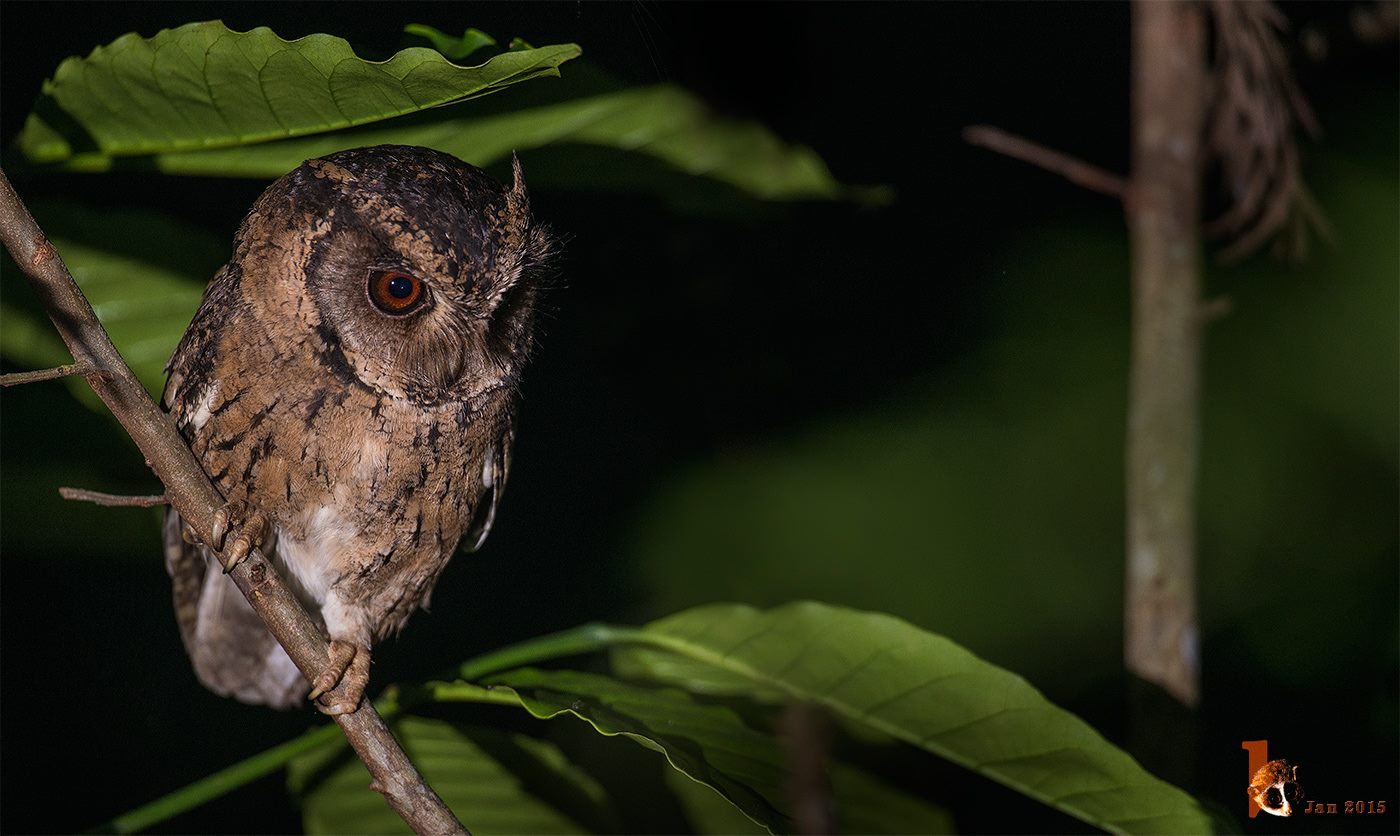
Common Name: Indian Scops Owl
Otus bakkamoena
Location: Nittor, Belur, Hassan, Karnataka, India
Sighting date: January 16, 2015
Photographer

Field Observation
An Indian Scops Owl observed at night, perched on a low branch within dense forest understorey in Kodagu. The bird is photographed in a three-quarter profile, displaying the characteristic small but distinct ear tufts, the broad pale facial disc with fine dark streaking and the cryptic brown and buff plumage that makes this species almost invisible against bark and foliage during daylight hours. The deep rufous-orange eye is clearly visible, reflecting the camera light. The surrounding broad-leaved vegetation and the dark forest background place this sighting within the interior or edge of a well-canopied landscape.
The Indian Scops Owl (Otus bakkamoena) is one of the most commonly heard but least often seen owls of peninsular India and the Western Ghats. Its distinctive call — a soft, repetitive two-note "whuut" — is a familiar sound of forest edges and plantation interiors after dark, yet the bird itself, pressed against a branch with plumage perfectly matching the bark, is routinely overlooked. This cryptic roosting behaviour is the species' primary defence against predation during daylight hours.
A small owl measuring 23 to 25 centimetres, the Indian Scops Owl is among the largest of the scops owls found in India. It feeds primarily on large insects, small lizards and occasionally small rodents and frogs, hunting from low perches in the understorey after dark. On coffee and spice estates across the Western Ghats it is a regular nocturnal presence, moving through the estate interior along shade tree rows and drainage channels where insect activity is highest.
The Indian Scops Owl nests in natural tree cavities and is a resident breeder across peninsular India. Well-managed coffee estates in Kodagu — retaining mature shade trees with natural hollows — provide both the nesting structure and the prey-rich understorey this species depends on. Its consistent presence on working estates is a reliable indicator of intact canopy structure and sufficient ecological complexity within the plantation landscape.
This photograph, taken in January 2015, captures the Indian Scops Owl in characteristic nocturnal pose — alert, watchful, perfectly camouflaged against the surrounding foliage. A quiet record of a species that shares the nights of Kodagu's coffee estates with equal claim to the landscape.