
- prev
- next
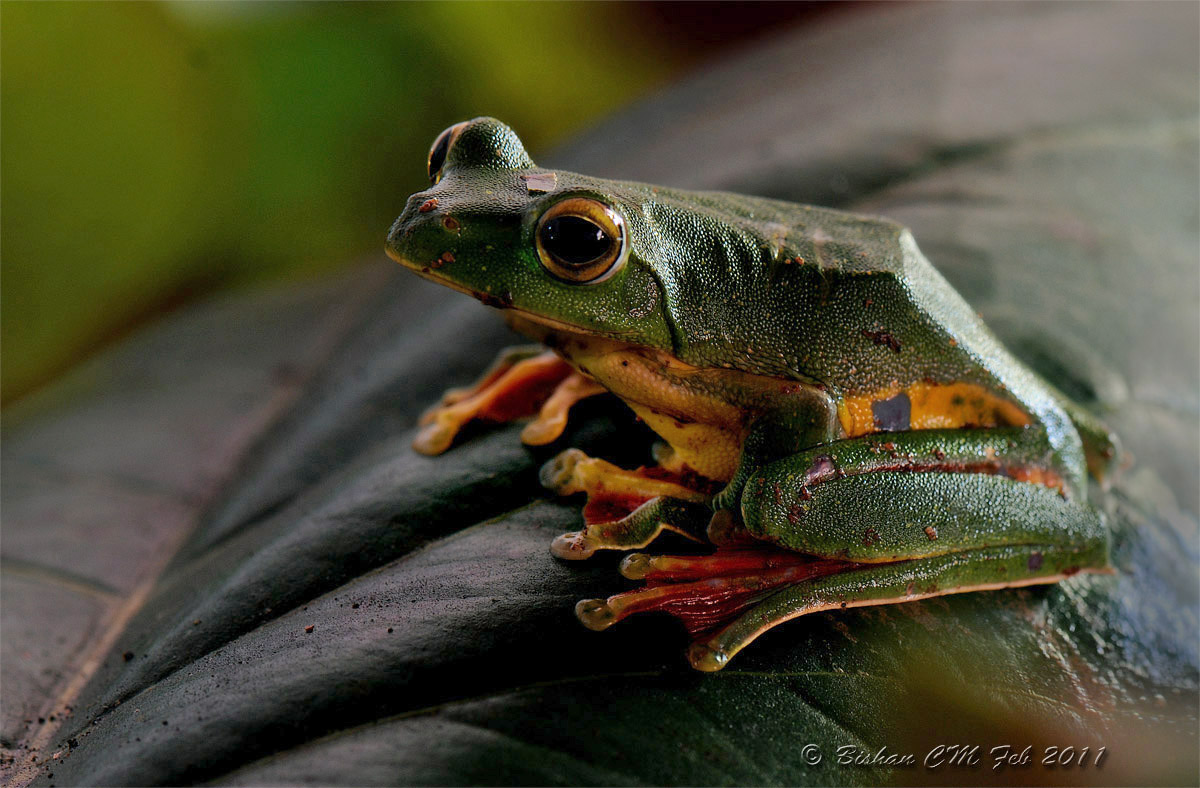
Common Name: Malabar Gliding Frog
Rhacophorus malabaricus
Location: Gonikoppal, Ponnampet, Kodagu, Karnataka, India
Sighting date: February 12, 2011
Photographer
Field Observation
A Malabar Gliding Frog observed at rest on a large leaf in Kodagu, photographed in February 2011. The frog faces the camera in a three-quarter profile, displaying the vivid green dorsal surface, the large golden eye with horizontal pupil and the distinctive orange-red webbing between the toes that gives this species its remarkable gliding ability. The pale yellow flanks and the finely granulated skin texture are clearly visible. The broad dark leaf on which the animal rests is characteristic of the moist forest understorey where this species spends most of its non-breeding life.
The Malabar Gliding Frog (Rhacophorus malabaricus) is one of the most iconic amphibians of the Western Ghats — endemic to this single mountain range and found nowhere else on earth. It is the State Amphibian of Kerala and one of the largest moss frogs in Asia, with females reaching up to ten centimetres in body length. Its most remarkable adaptation is the large, fully webbed hands and feet — the orange-red webbing visible in this photograph — which the frog extends to create a parachute-like surface when leaping from the canopy, allowing gliding jumps of nine to twelve metres, approximately 115 times its own body length.
Found across the Western Ghats in Karnataka, Kerala, Tamil Nadu, Goa and Maharashtra at altitudes ranging from near sea level to almost 1900 metres, the Malabar Gliding Frog inhabits primary and secondary forests, coffee plantations and riparian corridors. It is an arboreal species, spending most of its life in the lower canopy and forest understorey, descending to breed during the monsoon months of June to September. Breeding pairs build foam nests on branches overhanging water bodies — the male whipping the eggs and seminal fluid into a foam mass that protects the developing embryos until the tadpoles hatch and drop into the water below.
On coffee estates in Kodagu, the Malabar Gliding Frog is a regular presence wherever forest streams and water bodies are retained within or adjacent to the plantation. The species' dependence on overhanging vegetation above clean water for breeding makes it a sensitive indicator of riparian habitat quality — its presence on an estate confirms that water bodies are intact, unpolluted and sufficiently shaded. A February sighting, outside the monsoon breeding season, indicates a resident individual in its non-breeding arboreal habitat rather than a seasonal visitor.
Despite its Least Concern status, the Malabar Gliding Frog's population is declining due to deforestation, habitat fragmentation, intensive agriculture and the drainage of the small water bodies it depends on for breeding. Its continued presence in the forests and plantation landscapes of Kodagu is a measure of the ecological health of those landscapes — and a reminder that the amphibian diversity of the Western Ghats, among the richest in the world, depends on the decisions made about how these working landscapes are managed.