- prev
- next
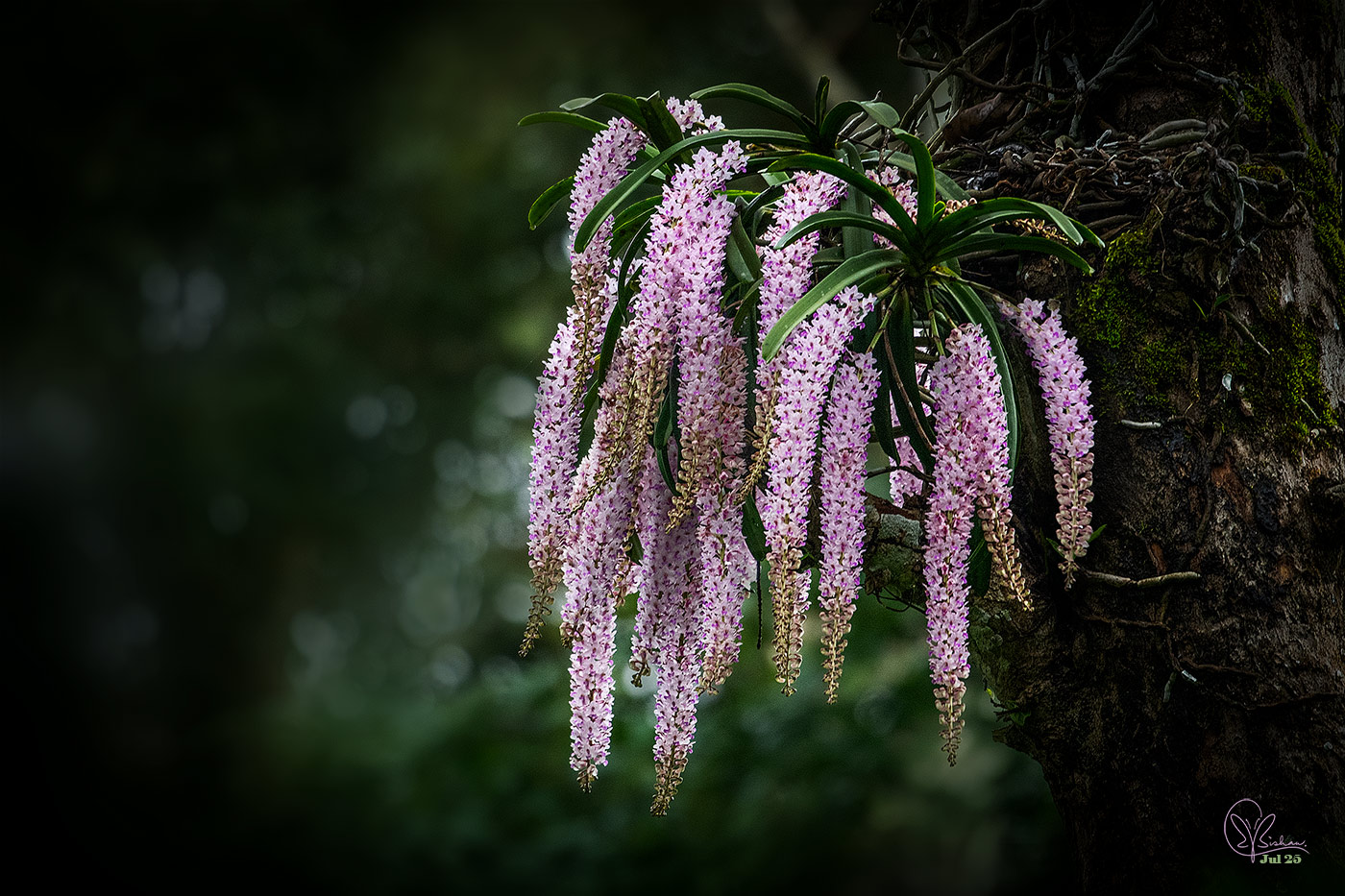
Common Name: Foxtail Orchid
Rhynchostylis retusa
Location: 571216, Ponnampet, Karnataka, India
Sighting date: July 28, 2025
Photographer
Field Observation
A Foxtail Orchid observed in full bloom, growing epiphytically on a moss-covered tree trunk in Kodagu. Multiple pendant racemes cascade downward from the plant, each carrying more than a hundred small pink-spotted flowers in the characteristic foxtail arrangement that gives the species its name. The dark forest background and the moss and lichen visible on the host tree bark indicate a well-shaded, high-humidity environment — precisely the microhabitat this epiphytic orchid requires. The July sighting represents the late end of the species' flowering season, which typically peaks between May and June across the Western Ghats.
The Foxtail Orchid (Rhynchostylis retusa) is one of the most visually spectacular epiphytic orchids of South and Southeast Asia, ranging from India and Sri Lanka through Nepal, Bhutan, Bangladesh and east to the Philippines. In the Western Ghats it is found growing on the bark of large trees in moist deciduous and evergreen forests, coffee estates and cardamom plantations — wherever the combination of filtered light, high humidity and host tree bark provides the conditions this orchid needs to establish and flower. It is entirely rootless in soil, deriving moisture and nutrients from the air and the surface of its host tree rather than from the ground.
The pendant racemes of Rhynchostylis retusa can carry well over a hundred flowers per inflorescence, the individual blooms waxy and faintly fragrant, attracting a range of pollinators including bees and butterflies. On coffee estates in Kodagu, where large native shade trees — Silver Oak, Jackfruit, Wild Mango — are retained as canopy over the coffee plants, the Foxtail Orchid finds abundant host surfaces on which to establish. Its presence on estate trees is a direct indicator of the age and continuity of the shade canopy — young plantation trees do not carry epiphytic orchid communities. A Foxtail Orchid flowering on an estate tree speaks to decades of undisturbed growth.
The species is under pressure across much of its range from collection for the horticultural trade and from loss of the large mature trees it depends on. Its continued presence in the forests and estate canopies of Kodagu reflects the ecological integrity of landscapes where old trees are retained and disturbance is low. This record, photographed by Dr. Bishan Monnappa in July 2025, documents a species that is both ecologically significant and increasingly rare in the wild — a quiet measure of the health of the landscape it inhabits.