- prev
- next
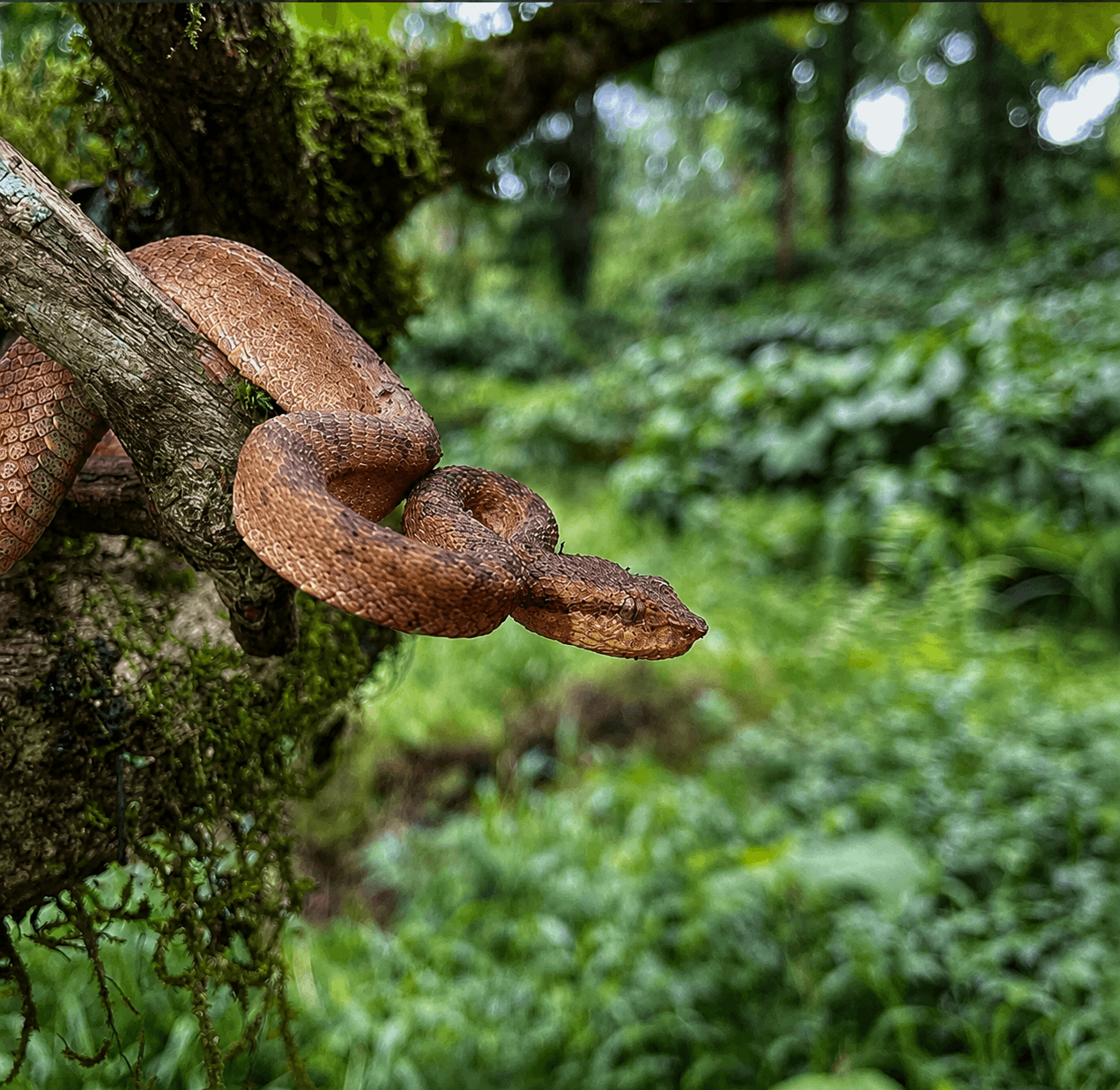
Common Name: Malabar Pit Viper
Trimeresurus malabaricus
Location: Kodagu, Karnataka, India
Sighting date: June 17, 2023
Photographer

Field Observation
A Malabar Pit Viper observed coiled on the moss-covered branch of a Peridinia coffee plant estimated to be over seventy years old, within a coffee estate in Kodagu. The individual displays the reddish-brown colour morph of the species — one of several colour variants found across the Western Ghats population of this snake, ranging from blue-green to yellow-brown to the rich rufous-red visible here. The triangular head is clearly visible resting on the coiled body, the heat-sensing pit organs characteristic of the Crotalinae subfamily discernible between the eye and nostril. The dense green forest understorey and moss-covered bark indicate a well-shaded, high-humidity microhabitat — precisely the conditions this species favours.
The Malabar Pit Viper (Trimeresurus malabaricus) is endemic to the Western Ghats, one of the world's eight biodiversity hotspots. It is among the most frequently encountered venomous snakes on coffee and spice estates across Kodagu, Wayanad and the broader Western Ghats landscape — found on low branches, shrubs, streamsides and among the vegetation of shaded plantation interiors. Its primary hunting strategy is ambush — remaining motionless for extended periods on a favoured perch, detecting warm-blooded prey through its heat-sensitive pit organs before striking.
The tree on which this individual is photographed carries its own ecological significance. A Peridinia coffee plant over seventy years old represents a living record of the estate's agricultural history — a variety once widely cultivated across Kodagu's estates, now increasingly rare as newer high-yield varieties have replaced traditional plantings. Old Peridinia plants develop substantial woody stems and complex branch architecture, their bark accumulating moss, lichen and invertebrate communities that in turn attract the small prey species — frogs, lizards, small rodents — that pit vipers depend upon. The age of this plant is not incidental to the sighting. It is the reason for it.
This record documents two layers of the estate landscape simultaneously — a snake of the Western Ghats and a coffee plant that has stood for seven decades. Both are evidence of a landscape that has been managed with sufficient continuity and restraint to allow ecological complexity to accumulate over time.